What Alarm Monitoring Actually Does After a Sensor Trips
Between a tripped sensor and a person showing up, there is a chain of steps, and each link in that chain is worth understanding.
October 13, 2026 · 4 min read
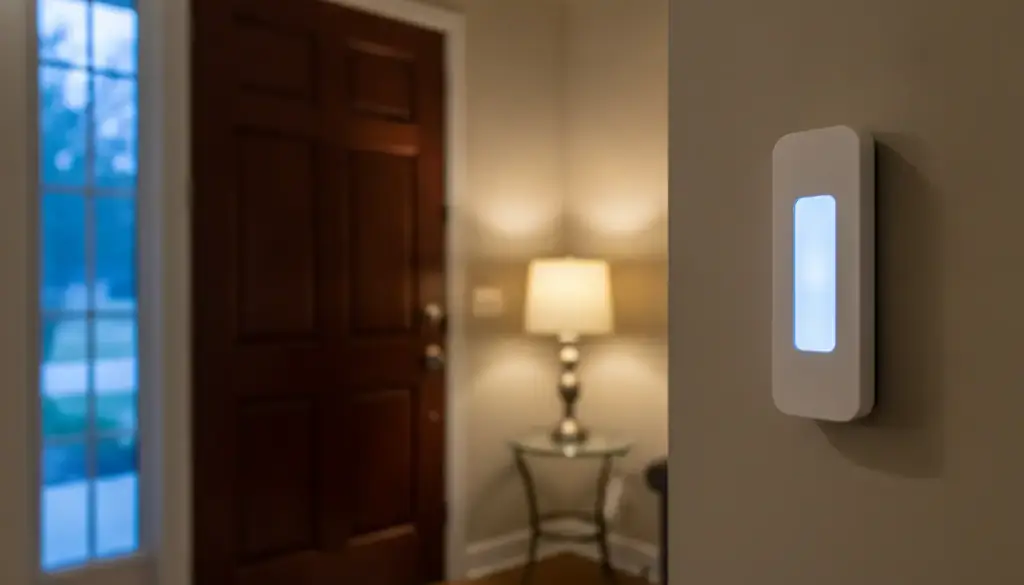
Most people know what an alarm sounds like. Fewer know what happens in the seconds and minutes after it goes off, and that part matters more than the siren. A monitored alarm system is really a chain: a sensor, a control panel, a communication path, a staffed monitoring center, and finally a person who responds. If any link is weak, the whole thing is weaker than it looks.
The signal leaves your building
When a door contact opens, a motion detector sees movement, a smoke detector senses smoke, or someone presses a panic button, the control panel is the first thing to react. It decides whether the event is one it should report, and if so it sends a message out. That message carries your account, the kind of event, and usually which zone or device caused it. A back door contact reads very differently from a smoke detector in a hallway, and the people receiving the signal need to know which one they are dealing with.
The panel can send that message over an internet connection, a cellular radio, or both. At Certified Alarm, our UL-listed central station monitoring runs over NetCom, with cellular backup and Halo wireless communications available as part of the picture. The point of having more than one route is simple: the signal has to get out even when the first route is not working.
What happens at the central station
A central station is a staffed monitoring center that receives alarm signals around the clock. Signals are sorted by type, because a burglary, a fire, a hold-up, a medical call, a panic button and a temperature alert each call for a different response. Each account has its own instructions, set up when the system was installed: who gets called, in what order, and when emergency responders should be contacted.
For many events, the operator will try to reach someone at the location or on your call list before taking the next step. That is why the system often asks for a passcode. If a family member sets off a door contact by accident, a quick call with the right passcode ends the matter. If nobody answers, or the passcode is wrong, the operator moves to the next step in your instructions. Exactly how this works depends on the event and on how your account is set up, so it is worth asking us to walk you through your own.
Why the signal path matters
An alarm that cannot reach the monitoring center is just a noisy box. Older systems relied on a single phone line, and a single line is a single point of failure. Someone who wants to defeat an alarm can cut a line outside the building. A storm, a construction crew or a failed piece of equipment can do the same thing by accident, and then the panel is talking into a dead connection while nobody at the other end hears a word.
A cellular backup gives the panel a second way out. If the primary path stops working, the panel can use the cellular radio to reach the monitoring center instead. That means a cut cable or an internet outage does not silently turn your alarm into a local-only siren. For a business that closes up at night, or a house that sits empty while the family travels, that second route is a big part of what you are paying a monitoring company for.
It also helps to ask how the system notices a problem with its own connection. A well-set-up system keeps checking that the path to the monitoring center is alive, and tells someone when it is not. If your current provider cannot explain how your system would tell you its connection had failed, that is a fair question to bring to your next conversation.
What you can do to make monitoring work better
Monitoring is only as good as the information behind it. Employees leave, family members change phone numbers, and a business moves its after-hours contact to a new manager. None of that updates itself in the monitoring center's records. A few habits keep your account useful:
- Review your call list at least once a year, and any time someone with a key or code leaves.
- Make sure everyone on the list knows their passcode and what to expect when the monitoring center calls.
- Tell your alarm company before a renovation, a long vacation, or any work that might trip sensors.
- Test your system on a schedule, and let the monitoring center know before you do so a test is not mistaken for a real event.
- Ask whether your system has a cellular backup, and whether it is active on your account.
None of this takes long, and all of it makes the difference between an operator who can reach the right person in one call and one who spends ten minutes working through outdated numbers.
Alarm monitoring is not magic, and it is not complicated either. A sensor reports, the panel sends, a trained operator follows your instructions, and someone responds. Your job is to make sure each of those steps is set up properly and kept current.
If you are not sure how your current system would handle a real event, Certified Alarm in Sheffield offers a free consultation, in person or by video on Zoom, FaceTime or Google Meet. We have been family-owned since 1960, and we are glad to look at how your signal gets out. Call us at (256) 406-2039.
Certified Alarm Company of Alabama Inc, (256) 406-2039
Call (256) 406-2039More articles
What a Fire Alarm Inspection Covers, and How to Prepare for One
An inspection is easier, faster and less disruptive when you know what the inspector is looking at before they arrive.
Choosing a Personal Emergency Button for a Parent Living Alone
The best device is the one your parent will actually wear, so the conversation matters as much as the equipment.